
The young and still highly volatile cryptocurrency market often throws up surprises. It's best to secure good surprises before they turn into bad ones.
To achieve this, traders have developed various techniques. We'll look at one of them in this article: Take Profit .
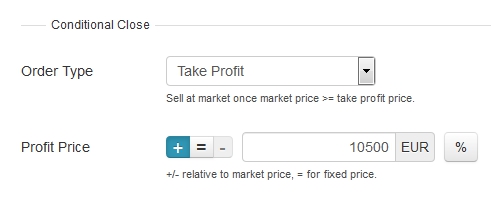
A Take Profit (TP) is a conditional order , meaning that it is not executed automatically on the market at the time of its creation, but when a condition is met. This takes the form of a price set in advance, which must be reached for the order to be triggered.
A Take Profit (TP) is a conditional order , meaning that it is not executed automatically on the market at the time of its creation, but when a condition is met. This takes the form of a price set in advance, which must be reached for the order to be triggered.
When this price is reached, the position is closed, the coins are sold in the case of an upward position ( long ), or bought in the case of a downward position ( short ). The objective of the TP is to be able to close a position when the price increases , in order to secure profits .
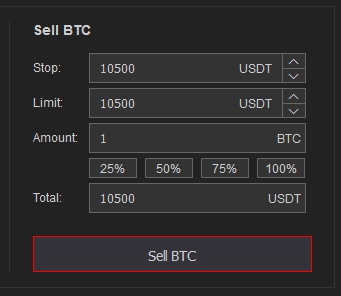
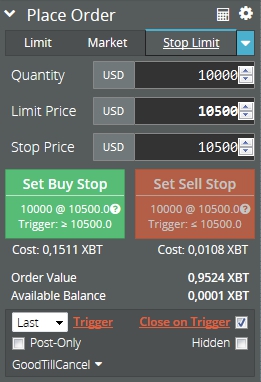
Example : I open a position of 1 Bitcoin at $10,000/BTC. I also place a Take Profit at $10,500. If the price reaches $10,500, my position will close automatically, and I will have made a profit of $500.
In some cases, the price may continue to rise after a Take Profit. It is better to lock in your profits , rather than see the price fall below its purchase price.
Example : I open a position of 1 Bitcoin at $10,000/BTC. I also place a Take Profit at $10,500. If the price reaches $10,500, my position will close automatically, and I will have made a profit of $500.
In some cases, the price may continue to rise after a Take Profit. It is better to lock in your profits , rather than see the price fall below its purchase price.
However, to assess the price at which the Take Profit would be best placed, we recommend using Technical Analysis indicators .
Take Profit is from the same family as another conditional order: Stop Loss .
Take Profit is from the same family as another conditional order: Stop Loss .